
.png "A Guide To Test Weights")
Our guide to test weights explores how they are generally used for routine testing by the user of scales and balances outside of an external calibration regime (which is carried out on an annual basis by authorised service technicians such as Northern Balance). Routine testing can, if carried out regularly, identify potential non-conformance of the users weighing process by detecting issues before any harm is done.
Test weights are grouped into classes that detail tolerance limits, or Maximum Permissible Errors (MPE) which are defined either by the International Organisation of Legal Metrology (OIML R111-1:2004) or the ASTM International (ASTM E617 – 18). In the UK and Europe, we refer to the OIML recommendations when dealing with test weights, the ASTM system generally mirrors OIML recommendations and is used in North America.
Contents
- OIML Classes Of Accuracy
- Nominal Value & Correct Class
- How Many/What Value Test Weights
- Handing Test Weights
- Tips For Weight Handling
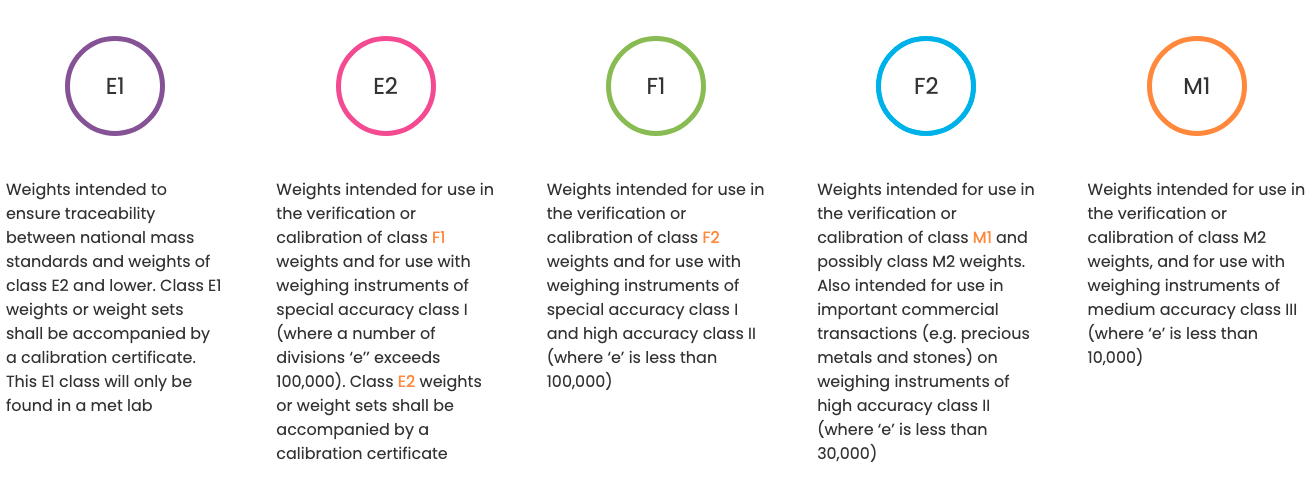
OIML R111-1: 2004 Classes of Accuracy E, F, M For Test Weights
Accuracy Classes for balances, which are defined as non-automatic weighing instruments, are found in BS EN 45501:2015 and are used to determine the accuracy class of weights required when testing or calibrating the instrument. The value “e” is the verification scale division a value, expressed in units of mass, used for the classification and verification of an instrument. Verification is the term used in Legal Metrology as passing an instrument as fit for use for trade and/or commercial transactions.
Depending on the use of the balance the ‘e’ value may not be relevant and the Balance has a readability value ‘d’, which is the smallest increment of measurement displayed, and can usually be found on the data plate of the balance (‘e’ is normally = 10 ‘d’) along with the maximum capacity. Work out the number of divisions by dividing the max capacity by ‘d’. If you do not know this information, consult the user manual for your balance or contact us with the model number and we will find out for you.
Determining the Nominal Value and Correct Class required for your Check Weights
You can now determine the correct class and nominal value of test weights that you require for the monitoring of the performance of your balance(s).
The following tables detail the errors on each class
| E1 | Maximum Permissible Error |
|---|---|
| +/- mg | |
| 1 mg | 0,003 mg |
| 2 mg | 0,003 mg |
| 5 mg | 0,003 mg |
| 10 mg | 0,003 mg |
| 20 mg | 0,003 mg |
| 50 mg | 0,004 mg |
| 100 mg | 0,005 mg |
| 200 mg | 0,006 mg |
| 500 mg | 0,008 mg |
| 1 g | 0,010 mg |
| 2 g | 0,012 mg |
| 5 g | 0,016 mg |
| 10 g | 0,020 mg |
| 20 g | 0,025 mg |
| 50 g | 0,030 mg |
| 100 g | 0,05 mg |
| 200 g | 0,10 mg |
| 500 g | 0,25 mg |
| 1 kg | 0.5 mg |
| 2 kg | 1,0 mg |
| 5 kg | 2,5 mg |
| 10 kg | 5 mg |
| 20 kg | 10 mg |
| 50 kg | 25 mg |
| Nominal Value | E2 |
|---|---|
| +/- mg | |
| 1 mg | 0,006 mg |
| 2 mg | 0,006 mg |
| 5 mg | 0,006 mg |
| 10 mg | 0,008 mg |
| 20 mg | 0,010 mg |
| 50 mg | 0,012 mg |
| 100 mg | 0,016 mg |
| 200 mg | 0,020 mg |
| 500 mg | 0,025 mg |
| 1 g | 0,030 mg |
| 2 g | 0,04 mg |
| 5 g | 0,050 mg |
| 10 g | 0,060 mg |
| 20 g | 0,080 mg |
| 50 g | 0,10 mg |
| 100 g | 0,16 mg |
| 200 g | 0,30 mg |
| 500 g | 0,80 mg |
| 1 kg | 1,6 mg |
| 2 kg | 3,0 mg |
| 5 kg | 8,0 mg |
| 10 kg | 16 mg |
| 20 kg | 30 mg |
| 50 kg | 80 mg |
| Nominal Value | F1 |
|---|---|
| +/- mg | |
| 1 mg | 0,020 mg |
| 2 mg | 0,020 mg |
| 5 mg | 0,020 mg |
| 10 mg | 0,025 mg |
| 20 mg | 0,03 mg |
| 50 mg | 0,04 mg |
| 100 mg | 0,05 mg |
| 200 mg | 0,06 mg |
| 500 mg | 0,08 mg |
| 1 g | 0,10 mg |
| 2 g | 0,12 mg |
| 5 g | 0,16 mg |
| 10 g | 0,20 mg |
| 20 g | 0,25 mg |
| 50 g | 0,3 mg |
| 100 g | 0,5 mg |
| 200 g | 1,0 mg |
| 500 g | 2,5 mg |
| 1 kg | 5 mg |
| 2 kg | 10 mg |
| 5 kg | 25 mg |
| 10 kg | 50 mg |
| 20 kg | 100 mg |
| 50 kg | 250 mg |
| Nominal Value | F2 |
|---|---|
| +/- mg | |
| 1 mg | 0,06 mg |
| 2 mg | 0,06 mg |
| 5 mg | 0,06 mg |
| 10 mg | 0,08 mg |
| 20 mg | 0,10 mg |
| 50 mg | 0,12 mg |
| 100 mg | 0,16 mg |
| 200 mg | 0,20 mg |
| 500 mg | 0,25 mg |
| 1 g | 0,3 mg |
| 2 g | 0,4 mg |
| 5 g | 0,5 mg |
| 10 g | 0,6 mg |
| 20 g | 0,8 mg |
| 50 g | 1,0 mg |
| 100 g | 1,6 mg |
| 200 g | 3,0 mg |
| 500 g | 8,0 mg |
| 1 kg | 16 mg |
| 2 kg | 30 mg |
| 5 kg | 80 mg |
| 10 kg | 160 mg |
| 20 kg | 300 mg |
| 50 kg | 800 mg |
| Nominal Value | M1 |
|---|---|
| +/- mg | |
| 1 mg | 0,20 |
| 2 mg | 0,20 mg |
| 5 mg | 0,20 mg |
| 10 mg | 0,25 mg |
| 20 mg | 0,3 mg |
| 50 mg | 0,4 mg |
| 100 mg | 0,5 mg |
| 200 mg | 0,6 mg |
| 500 mg | 0,8 mg |
| 1 g | 1,0 mg |
| 2 g | 1,2 mg |
| 5 g | 1,6 mg |
| 10 g | 2,0 mg |
| 20 g | 2,5 mg |
| 50 g | 3,0 mg |
| 100 g | 5 mg |
| 200 g | 10 mg |
| 500 g | 25 mg |
| 1 kg | 50 mg |
| 2 kg | 100 mg |
| 5 kg | 250 mg |
| 10 kg | 500 mg |
| 20 kg | 1000 mg |
| 50 kg | 2,500 mg |
How Many And What Value Test Weights Do I Need?
How you use your balance, how many balances you have and your Quality Management System will determine how many and what nominal value test weights you require.
If you only use the balance at a specific value you may only need a single weight to complete your routine monitoring and testing. However, if you have multiple balances, with multiple maximum capacities and use each one at differing values then you will need a range of test weights to complete your routine monitoring and testing.
Be aware though that although you can use higher accuracy weights for lower accuracy balances you cannot use lower accuracy weights for higher accuracy balances. The reason for this is that, even though the test weights are calibrated, you must take into account not only the stated error on the calibration certificate but also the uncertainty of that measurement. It is a parameter, associated with the result of a measurement (e.g. a calibration or test) that defines the range of the values that could reasonably be attributed to the measured quantity, such as environmental factors and air buoyancy and even gravity